I gained more value in one 45-minute conversation with Sourav than I did in a two-week engagement with some of these other consultants.
How eCommerce Founders Break Past 7-Figure Scale
Most eCommerce brands plateau between $15K and $30K/month — not because the product is wrong, but because the structure is. This is the framework that fixes the structure.
Revenue is real. Somewhere between $15K and $90K a month. But growth has stalled — and you can't figure out why.
Below $3K/day, almost every eCommerce brand is trapped in the same cycle: low revenue means low traffic, low traffic means bad data, bad data leads to wrong decisions, wrong decisions waste money, less money means less traffic. The spiral tightens.
ROAS, conversion rate, CPM — these metrics can't tell you what's wrong. Because the real problem is structural, not tactical.
If you've been searching for any of these — this blueprint addresses them directly:
I gained more value in one 45-minute conversation with Sourav than I did in a two-week engagement with some of these other consultants.
Took my business from £200/week to over £1k/day in 3 months.
Your depth of knowledge is unmatched — even the largest consulting firms I talked to here in the States couldn't show me a game plan.
This isn't a list of tactics. What changes is how you see your business — and every decision you make from here.
| # | Chapter | What You'll Understand |
|---|---|---|
| 1 | You | Why the founder is the single biggest variable in whether this works — and what to look at honestly |
| 2 | Before You Start | The 4-pillar readiness diagnostic: proven PMF, defensible moat, unit economics, and operational capacity |
| 3 | The Low-Revenue Cycle | Why your store keeps bouncing around $1K/day — and why trying harder at the same stage makes it worse |
| 4 | eCommerce Finance Basics | How to calculate your true profit (not platform ROAS) — and the cash timing gap that makes profitable brands go broke |
| 5 | Stop Wasting Time on the Wrong Metrics | Why ROAS drops every time you scale — and what to actually track instead |
| 6 | The Revenue-First Mindset | Why optimizing before scale is the biggest mistake founders make — and the milestone model from $500 to $3K/day |
| 7 | The Fishing Analogy | Why $50/day on Meta feels like it's not working — and when scaling spend is the right call vs. the wrong one |
| 8 | Organic Content | The vertical video system for compounding organic traffic — and how it reduces your paid CAC over time |
| 9 | Meta Ads | The exact campaign structure for brands under $3K/day — CBO vs ABO answered, budget scaling rules, auto-rules, and how to read performance correctly |
| 10 | Creative Differentiation | How to test ad creatives without burning budget — and what creative differentiation actually means post-iOS14 |
| 11 | The Credit Card Strategy | How to extend your cash runway by 45–55 days using business credit — and fund ad spend without draining your bank account |
| 12 | The Broader Cash Flow Framework | The full cash flow model — how to read the gap between P&L profit and actual cash, and plan 30–60 days ahead |
| 13 | Inventory and Demand Planning | The demand planning method that stops stock from killing your momentum — variant-level, revenue-target driven |
| 14 | Capital, Debt, and Credit | Alternatives to Shopify Capital — ranked by actual cost, with a cautionary tale on revenue-based financing |
| 15 | What Happens Next | Where to go once you're consistently at $3K/day — and how to access mentorship if you need it |
This is what matters most to me — founders reaching out to share how our work together moved the needle.
More proof from founders across the world:


.png)


1,000+ founders from 60+ countries have applied this framework over 10+ years.
Here's what drives me to keep doing this work:
I love working with 7-figure+ brands. Money is good. It pays my bills. I want to keep working with more 7-figure+ brands in any capacity possible.
But I crave something different too.
I want to get involved with brands that have huge potential — either in their early days, at a smaller stage, or when their eCommerce is still below seven figures. I want to lay the foundation and build the systems and structures for growth, brick by brick.
I've spent 10+ years in eCommerce growth, working with 1,000+ brands. I work as a fractional CMO for 7-figure DTC brands — leading growth for brands spending $1M+/quarter on advertising.
After a decade running a digital agency, I pivoted to working directly with a small number of 7-figure brands while building this resource hub — so bootstrapped founders can access the same level of thinking that usually costs $10K+/month.
I also work with early-stage brands that have huge potential. I want to lay the foundation and build the systems and structures for growth, brick by brick — and take them from scratch to seven figures and beyond.
No fluff. No vanity metrics. No agency bloat. Clear strategy, honest audits, and systems built for lean teams.
Questions or custom engagements: business@souravghosh.com
A 15-minute consultation with a founder stuck below consistent daily revenue — and the exact framework shift that changed everything.
$3,000/day average daily sales = $90,000/month = $1 million/year. Until you hit that number, almost nothing else you do will have meaningful impact. Website redesigns, email campaigns, blog articles, conversion rate fixes — none of these move the needle when your daily traffic is below 200 sessions. At $90K/month, roughly 10% ($9,000) can go toward operational expenses — expert help, better tools, agencies. Below that threshold, you can't access the resources that would actually move things forward.
Every single day, before spending time on any business activity, ask yourself in this exact order: (1) Can this bring a sale today? (2) If not — can this bring an email subscriber today? (3) If not — can this bring new website traffic today? (4) If not — can this bring new distribution or attention today? If the answer to all four is no, that activity is not a priority right now.
Website optimization/design reviews: your traffic is too low — even doubling conversion rate barely moves sales. Email marketing: max 1 hour/week total — your list is small and only grows when you bring more people to the site. Blog writing/SEO: takes 3–6 months and only pays off at scale. Redirect that time to channels that can work this week.
Shoot on mobile. Edit using Instagram's built-in editor or TikTok's native editor. Post the same video across Facebook, Instagram Reels, and YouTube Shorts. Start with 3 videos/week → 1/day → 2–3/day. Research what's trending in your product category. Add a 5-second end screen: "Order yours today from [your website]." That one detail is the difference between content people enjoy and content that drives sales.
Real example: a brand with 1 million followers and thousands of studio videos had near-zero website traffic and daily sales. Viewers were watching as pure entertainment — they didn't realise a product was for sale. Every video must make it clear — at minimum in the final 5 seconds — that the product is available to buy.
After 2–3 weeks: are views increasing video by video? Is daily website session count going up in parallel? When a video gets high views, do you see a traffic spike on your site? If a format works, do more of it. If something shows zero correlation after 1–2 weeks — stop it immediately and try something else.
Once your organic content shows a clear link between views and sales: find micro-creators just starting out, willing to work for product + a small monthly sponsorship. You're not paying for their audience — you're paying for consistent content production at low cost. Scale to one creator video per day alongside your own.
Don't wait years for organic to build. Focus on Contribution Profit, not ROAS. Contribution Profit = Net Sales minus Cost of Delivery (product cost, fulfillment, shipping, payment processing) minus Ad Spend. Real example: took a brand from $100/day to $1,000/day in ad spend in 14 days. The founder panicked until shown the absolute profit number — then immediately understood why scaling made sense.
This is the thinking behind the framework — written and recorded for founders, freely available. If you want a taste of the depth before you buy, start here.
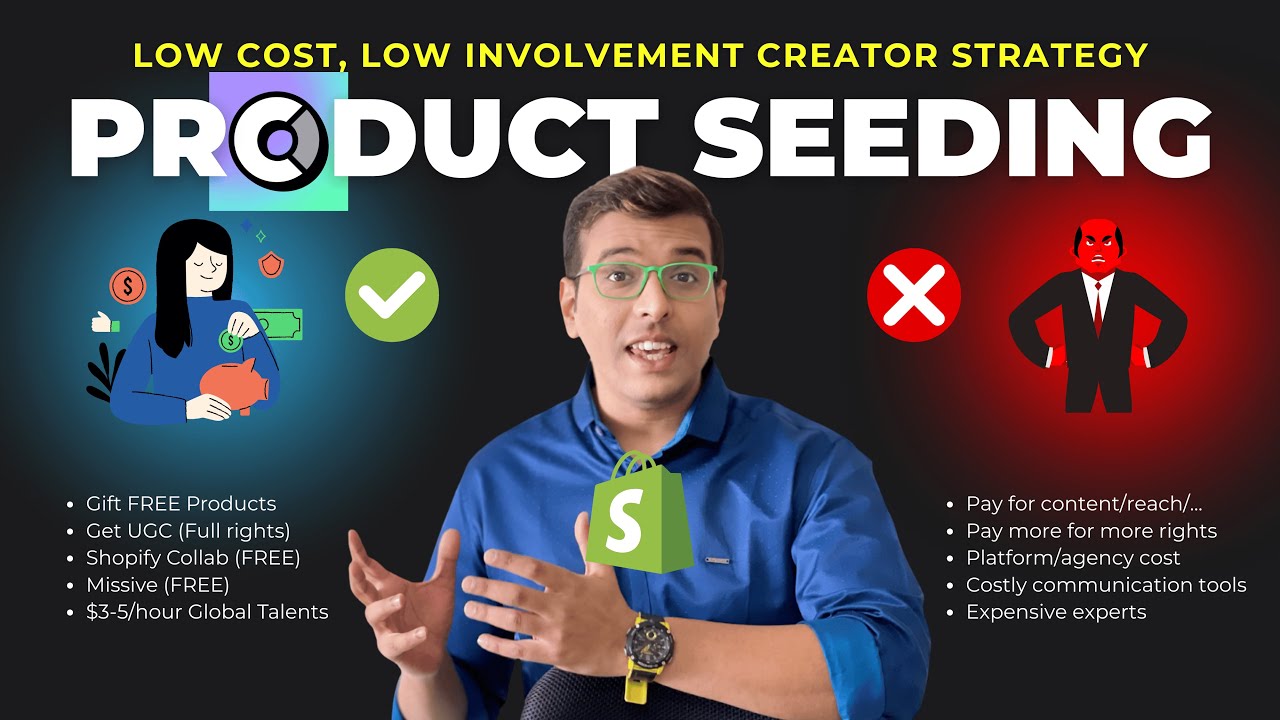
Watch: Shopify Collab Product Seeding Campaign Workflow — Low Cost eCommerce Creator Partnership Strategy
Many eCommerce brands I met over the last decade were desperately trying to solve problems with their Meta Ads, website, CRO — and completely overlooked the fact that they didn't have product-market fit. This piece breaks down why PMF is the invisible ceiling on your entire business.
Read on SubstackYou've built a 7-figure business on excellent products and happy customers. But growth has plateaued — and the strategies that got you here aren't enough anymore. This is the framework for what comes next.
Read on SubstackQuestions from founders on Reddit and X — answered with the same depth I bring to every consultation.
Consistent traffic and sales require at least 2-3 discovery paths so revenue doesn't go silent when one channel cools off. Most founders have a traffic problem, not a conversion problem — but they spend time on website improvements when the dial isn't turning. Vertical video is the highest-leverage acquisition channel at early stage because it compounds over time and generates organic discovery. Beyond that, think distribution: where do your ideal customers already buy? If you're not present in those places (boutiques, marketplaces, multi-brand retailers, wholesale platforms like Faire), consistent growth stays hard regardless of how good the website looks. On paid: one broad CBO campaign with 5-10 differentiated creatives is simpler and more effective than multiple ad sets. Track blended CAC (total ad spend divided by total Shopify orders in the same period) and blended ROAS (Net Sales divided by total ad spend) — not Meta's platform numbers.
Read my full answer →Diagnose at the finance level first, not the ad account. Pull a monthly P&L view: Net Sales, COD (Cost of Delivery — product cost, pick/pack, outbound shipping, payment processing), Gross Profit, Ad Spend, Contribution Profit (what's left after both COD and ad spend are subtracted from Net Sales). If Contribution Profit dollars are up month-over-month even at a lower margin percentage, don't panic about a worse CAC number — the business is healthier. If CP is flat or shrinking, then work through: Is this blended CAC (total ad spend divided by total Shopify orders) or platform CAC from Meta? Are you separating new-customer CAC from returning-customer CAC? Did AOV move alongside CAC? Then check the funnel (CVR, ATC rate, checkout rate) before going into the ad account itself. In the ad account: high frequency plus rising CPM typically means top-of-funnel isn't being fed enough. Creative differentiation — different formats, visuals, texts, personas — is non-negotiable in the current Meta environment.
Read my full answer →You're likely trying to solve the wrong problem first. At $50K/month revenue and $10K/month ad spend, start with the P&L, not GA4. Build a simple monthly view — Net Sales, COD, Gross Profit, Ad Spend, Contribution Profit, OPEX, Net Profit — over the last 3-6 months. A 20% MER (Marketing Efficiency Ratio — ad spend as a percentage of Net Sales) can be strong on the paid media side, but it doesn't capture what's happening in OPEX. On the tracking mismatch: Google vs Shopify vs Meta not agreeing is normal. No identity resolution tool will tell you scientifically whether your $5K TikTok spend is worth it — those systems under-credit upper-funnel channels by design. Before any identity tool: tighten abandoned browse, cart, and checkout flows first. Then focus on zero-party data — getting more visitors into your CRM earlier. LiveRecover is worth a look for checkout recovery specifically: real-time 1:1 SMS conversations by live agents, integrates with Klaviyo, setup takes about 10 minutes.
Read my full answer →The grind doesn't stop automatically at revenue milestones — it shifts. The immediate fix for 250 daily CS emails: an AI-powered omnichannel helpdesk (affordable options: kim.cc, Commslayer; top-tier: Richpanel). Self-serve is the highest-leverage lever — order tracking, returns, FAQs handled without any ticket touching a human. After $90K/month, you have enough MER budget headroom to hire affordable global talent at $3-5/hour for 100-300 hours of execution work. Below $90K after 3 years is what's called the Black Hole of DTC — a lot of brands with real potential die there. At sub-$3K/day revenue, this is almost always a traffic problem, not a logistics problem. The Traffic Dial concept: you need a repeatable mechanism that converts inputs (ad spend or content published) into predictable visitors. Without a dial that works, you get no traffic, no data, unreliable signals, and bad decisions — a compounding spiral.
Read my full answer →The framework is Learn, Systemize, Delegate. You can't effectively hire or evaluate others if you don't understand what needs to be done yourself — you'll have no way to catch when someone is taking you for a ride. Phase 1 (months 1-6): learn product sourcing, basic Shopify, Meta ads fundamentals, vertical video, email basics, and financial tracking. Focus on selling products, not perfecting the website — this is the biggest mistake from new founders. Phase 2 (months 6-18): once you know what works, document processes as SOPs, then delegate specific tasks (not broad roles) to $3-5/hour Upwork talent. Don't spend on agencies, course gurus, or expensive apps before $50K/month profitably. The unit economics that matter: COD (product cost + pick/pack + shipping + payment processing), Gross Profit per order, and the max you can pay to acquire a customer while keeping the business viable.
Read my full answer →Prioritize in this order. First, vertical video — one video daily posted across Instagram Reels, TikTok, Facebook Reels, YouTube Shorts. Introduce yourself as the face of the brand. This is the most exposure per time invested at early stage. Second, traffic before conversion — if you don't have consistent growing traffic, don't spend hours on Klaviyo A/B testing or website improvements. Get found first, then optimize for those visitors converting. Third, product seeding over paid UGC — don't pay $3K-5K for influencer posts. Send free products to micro-creators under 10K followers in exchange for content with full commercial usage rights. Fourth, one simple Meta CBO campaign (one ad set, broad targeting, 5-10 differentiated creatives) once you have content. Fifth, Google Merchant Center optimization before Google Ads. Everything goes back to one financial check: does your COD (product cost + pick/pack + shipping + payment processing) leave enough Gross Profit to support the CAC your paid channel is generating?
Read my full answer →It works well — but only if you treat it like operations, not hiring an expert. The process: write a very detailed job description with budget ($3-5/hour, stated explicitly), a strict 2-hour paid trial, what success looks like, what will get the contract ended fast, how communication works, and a "proof you read this" instruction (e.g., start proposal with a specific word). Hire for execution only — at this price point you're hiring someone who can follow a checklist, not someone exercising judgment. Break work into specific tasks, not broad roles ("schedule 30 posts using this SOP and this folder" — not "social media manager"). SOPs plus screen recordings are the whole game: record yourself doing the task correctly, turn it into a step-by-step with screenshots, define the exact definition of done. No calls with applicants — calls select for confidence, not execution. Strict 2-hour paid trial. When something goes wrong, update the SOP — don't coach the individual.
Read my full answer →Start with an AI-powered omnichannel unified helpdesk — every message from every channel (email, SMS, social DMs, comments, site chat) lands in one inbox, agents reply from one place, and every conversation is tied to the customer profile and order history. Affordable options: kim.cc, Commslayer. Top-tier: Richpanel. The highest-leverage lever is self-serve, not AI — make order tracking, returns, and common FAQs deflectable without any human touching the ticket. Self-serve reduces ticket volume even without increasing AI usage. Once self-serve and a unified inbox are working, layer AI on top for first-draft replies on the simplest repeated queries. Don't automate before the foundation is solid.
Read my full answer →Work only with creators who agree to publish at least one Reel with full commercial usage rights in exchange for free products — no per-content fee. Use the free Shopify Collab app for gifting and program management. Find targeted micro-creators (under 10K followers, over 5% engagement rate, posted in last 7 days) using the free Meta Creator Marketplace and TikTok Creator Marketplace. Invite email must include: "By participating, you agree to: share at least one vertical short-form video, send it directly or tag us as a collaborator, and grant us full commercial rights to use your content across marketing, site, and ads." Once the workflow is documented in a detailed SOP with screen recordings, hand the entire outreach and follow-up to a $3-5/hour Upwork VA. Use Tolstoy on the website to display published creator videos as social proof and as a creative asset library for onboarding new creators.
Read my full answer →Q1 CPM spikes are real and structural — end of Q1 is when big brands rush to deploy budgets before close, tightening the auction. But the more important diagnosis is this: the CPM spike is exposing a unit economics problem, not creating one. At AOV $55 in jewellery, COD (product cost + packaging + pick/pack + outbound shipping + payment processing) likely eats 50-60%, leaving around $22-28 in Gross Profit per order. In January, when CPMs were lower, your blended CAC (total ad spend divided by total Shopify orders, same period) probably sat under that Gross Profit threshold — meaning each sale generated positive Contribution Profit. In March, the same creative efficiency delivers fewer purchases per dollar. Once blended CAC crosses Gross Profit per order, every sale costs money before overhead. Pull Shopify data, back-calculate actual blended CAC week by week. That's where the real signal is.
Read my full answer →Separate every hiring need into three buckets before posting any job. Guidance: when you don't know what to do. This is worth paying for only if it produces faster correct decisions and a short prioritized plan — if it doesn't change decisions inside 1-2 weeks, it's just conversation. Execution: when you know what to do but don't have capacity. Hire cheap here, but only for tasks that are specific, documented, and handed off with SOPs. Hiring cheap for judgment is a mistake. Leadership: when you need someone to own an outcome end-to-end. This is expensive for a reason. Two non-negotiables regardless of which bucket: no long retainer before proof of delivery, and evaluate the fulfillment team (the doers), not the salesperson or the pitch deck.
Read my full answer →Treat it as two separate problems: missing the fit feedback loop, and the product page forcing customers to guess. On data capture: stop asking "why are you returning?" and ask a forced-choice fit diagnosis instead — size bought, size they wish they'd bought, and 1-2 body-area specifics relevant to that product (waist/hip/thigh for pants, chest/shoulder for tops). Keep it 10-20 seconds — if it feels like a survey, customers won't complete it. Build a simple fit issue taxonomy and map every return into a bucket weekly. Once you have 100+ returns tagged, you'll typically find 1-2 patterns causing most of the problem. On the PDP: put fit/size help within thumb reach of Add to Cart on mobile. Add one dedicated carousel slide that's only fit guidance — customers actually swipe it. Social commerce compounds this: consistent vertical video on fit tips and "we heard you" updates from return feedback builds a community that gives honest fit feedback proactively.
Read my full answer →ROAS is the wrong starting point for a profitability conversation because it doesn't account for what the business is actually keeping. The right question is: what is your Net Profit after accounting for Cost of Delivery, ad spend, and OPEX? A "better ROAS" promise from a media buyer or agency often hides whether the additional revenue actually generates more net profit once their fee increase is factored in. ROAS can also be measured differently across platforms (in-platform, blended, MTA, different attribution windows) — so before accepting any ROAS-based claim, clarify exactly how it's being measured and against what baseline. Blended ROAS — Net Sales divided by total ad spend from Shopify, not Meta's own reporting — is the only version that maps to real business outcomes.
Read my full answer →Don't use Meta's own recommendations. Build two reports and run them daily and monthly in parallel: your actual business financials (Net Sales, COD, Gross Profit, Ad Spend, Contribution Profit) and your Meta account-level report. The account-level metrics that matter most are: amount spent, CPA, AOV, AP (Ad Profit = purchase conversion value minus amount spent — a proxy profit metric within the platform), and APT (Ad Profit per Transaction = AOV minus CPA, which removes volume bias when comparing different spend levels). The scaling signal is clear when an increase in daily ad budget shows up as higher AP in the platform report AND higher Contribution Profit in the backend financial report. If you have inventory and that dual signal is present, scale budget as fast as the economics allow. For budget allocation across multiple campaigns: compare AP and APT at similar spend levels — more budget goes to the asset generating higher AP, then verify that account-level AP and backend Contribution Profit both move up.
Read my full answer →For brands spending under $10K per day on Meta, the practical return from formal incrementality testing is likely not worth the complexity it introduces. A brand at $10K per day is spending $300K per month — even if incrementality testing saved 10% of that spend ($360K per year), that saving only matters if the brand doesn't already have a clear line of sight between its Meta spend and its backend financial results. The more useful question at this stage is: does increasing Meta budget reliably produce a corresponding increase in Contribution Profit in your Shopify backend? If yes, you don't need an incrementality test to tell you to keep spending. The conversation around incrementality becomes more relevant when you have multiple meaningful channels (Meta plus a solid second channel, plus organic baseline) and need to validate how dollars should be allocated across them — not when Meta is your single primary growth source.
Read my full answer →No single measurement solution — in-platform data, MTA, incrementality testing, or MMM — is the one true answer. Each has blind spots. The more durable approach is building one centralized, shared data system that connects ad platform performance to backend financial results: shared dashboards, key KPIs the entire organization is trying to move, and a common definition of success anchored to Contribution Profit and Net Sales rather than platform-specific attribution credits. A metric like aMER (adjusted Marketing Efficiency Ratio) can serve as a north star, but it should be interpreted alongside your full P&L context — organic improvements will also lift aMER, which doesn't mean you should redirect more paid media budget. Third-party attribution tools are most valuable when you have genuinely complex multi-channel spend and need to reduce internal disagreement across teams — not as a substitute for tracking actual business outcomes.
Read my full answer →Most fast-growing DTC brands have a fragility problem they don't see until it's too late: the brand's performance depends entirely on one or a few exceptionally talented individuals — the founder, a star media buyer, a top-performing creative director. When those people leave (and they always do eventually), the brand often starts to crumble — not because the product is bad, but because the operating system was never documented. The fix isn't replacing people with systems in a way that feels mechanical. It's creating directional guidance and a contingency plan: documenting core processes (Meta ads, creative, customer support, hiring) in a format simple enough that someone new can follow them. Not set in stone — fluid and regularly updated. The brands that last run on systems that attract great people and survive turnover, not on the brilliance of specific individuals.
Read my full answer →Growing a DTC brand is hard. Growing it profitably is harder. Anyone telling you otherwise is selling something. The DTC space has a structural misinformation problem: gurus with millions of subscribers preach how easy it is through content and courses, and the SaaS platforms funding their affiliate income amplify their reach. That creates a steady stream of new founders losing money, time, and sometimes their mental health before they either give up or face reality. The operators who have built 9-figure brands are the ones worth listening to — and their message is consistently the opposite of "it's easy." Understanding the basics of eCommerce business finance is the single most reliable filter: once you can read a P&L and understand the real COD (Cost of Delivery — product cost, pick/pack, packaging, shipping, payment processing), Gross Profit, and Contribution Profit, you can immediately see through most "proven system" claims.
Read my full answer →Both extremes are wrong. Trying to add new channels when you're already struggling with the ones you have — juggling more balls while dropping the existing ones — is not a strategic move. But being so concentrated on a single channel that your revenue is entirely dependent on it creates a different kind of fragility, especially in volatile economic conditions. Strategic diversification — where you expand into new channels from a position of operational strength, with a solid team and a documented framework — is a genuinely smart risk management move. The distinction is whether the diversification decision is driven by opportunity and capability, or by restlessness and novelty-seeking. If your current primary channel is performing well and your team can sustain it, adding a second channel with a clear purpose (organic baseline, email, wholesale, marketplace) is how you build a brand that doesn't die when any one platform has a bad quarter.
Read my full answer →It depends on where your brand sits in the market. For brands in the high-end or luxury segment — where customers are already paying a premium beyond the product's utilitarian value — investing in a premium unboxing experience makes financial sense. Customers who pay a premium for the product itself will convert at higher rates and become brand advocates when the full post-purchase experience matches that premium expectation. And critically, the cost of premium packaging is already priced into what they paid — it doesn't compress margin, it captures what the market is already willing to bear. For brands competing on value or selling commodity-adjacent products, premium packaging is a cost increase with uncertain return. The practical unit economics question is: can you price the premium packaging into your selling price without losing conversion, or does it come out of Gross Profit? If it comes out of Gross Profit and you're in a value-competitive category, it's a cost you likely can't absorb at early stage.
Read my full answer →No FAQs match this filter.
The founders who follow this stop troubleshooting ads and start reading their business. That shift is worth more than any campaign fix.
Immediate download · No subscription · No fluff